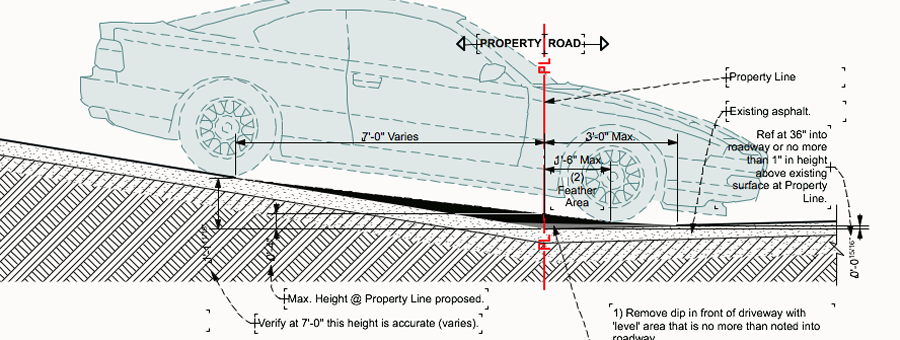
When a driveway is too steep as it intersects with the roadway, it can cause property damage by allowing the bottom of vehicles’ bumpers to scrape on the asphalt. Further, there can be scratch marks in the driveway where the bumpers of trucks have failed to clear the surface when trying to enter the property, shortening the lifespan of the driveway. This modest modification at the transition can eliminate those issues.
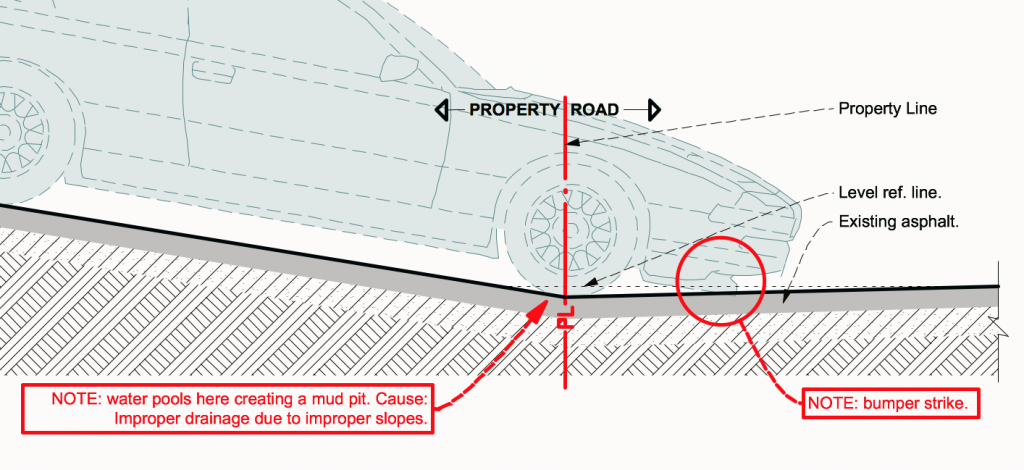
In the above image one can see how the bumper hits the pavement, something one wouldn’t expect during normal construction when the driveway itself is sloped as recommended.
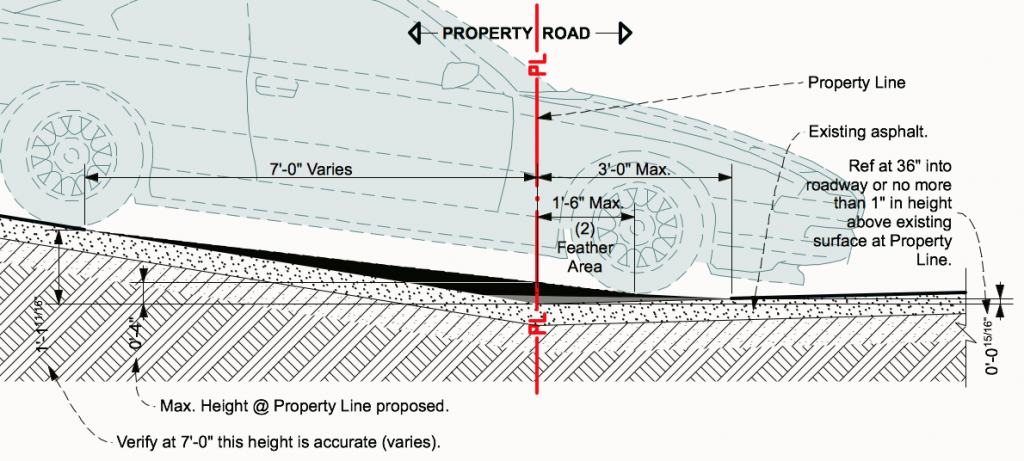
When creating a transition, one must not create a bump in the roadway, and so must create a smooth transition of at least 7 feet in length along the curb on both sides. This will allow traffic to move over the transition without noticing a change in elevation.
The steps in shaping the transition include:
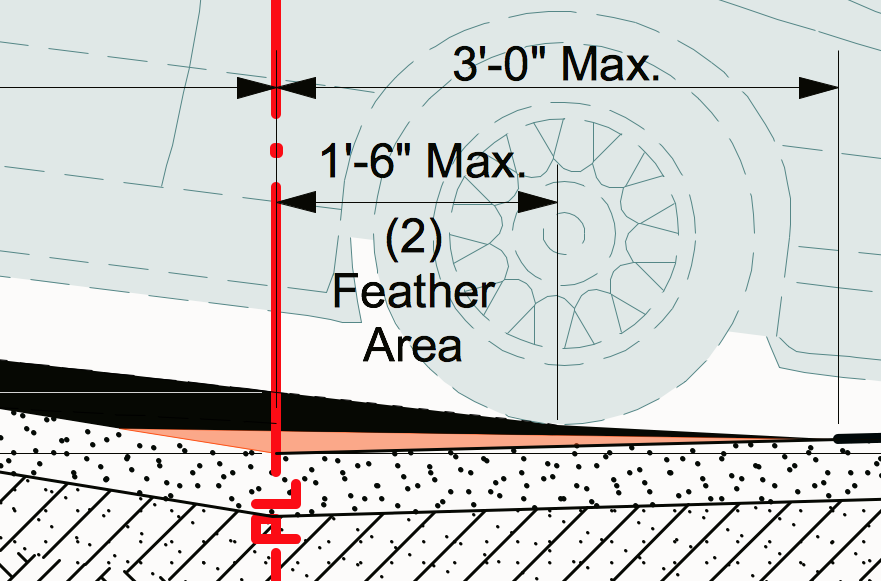
1) Remove dip in front of driveway with ‘level’ area that is no more than noted into roadway (see red shaded area below).
2) Start slope up driveway with ‘Feather Area’ into road of no more than noted.
3) Extend new slope at least 7 feet up the driveway. This may vary especially if the driveway isn’t perpendicular to the roadway.
4) Ends of new asphalt projecting into road will be feathered. Feathering will begin 18″ before edge of driveway and carry another 72″ beyond edge of driveway to ensure smooth transition.
CONSTRUCTION:
It is important to make this transition a permanent part of the driveway and road. This means removing existing material so that the new pavement is around 3 inches thick or as recommended, and not a sliver of material as shown in the diagrams. If creating a more permanent solution with concrete, make sure the slab is at least 6 inches deep by 8 inches wide and install two #3 rebars 2″ from the bottom of the slab. This would create a nice transition that asphalt could then transition to.
Note that in this example, we’ve raised the driveway just 4 inches at the property line, enough to do the trick.
For more useful tips, see our categories in the right column at www.simpletwig.com/blog. Be sure to follow us on Instagram to view our weekly content at instagram.com/simpletwig.
What about drainage along the side of the road at the property line? Your drawing shows adding height to the driveway at the property line which would interfere with drainage along the side of the road.
Hi Jennifer, you make a good point. In the diagram I indicate PL (Property Line) but this actually indicates where the existing driveway transitions to the road. The actual PL is a few feet towards our property which is common among most properties in the US. Still, this question is legit, in that I am implying that I am extending the driveway into the road. Knowing that getting the city to provide a transition to the new height of the driveway wouldn’t happen until the entire road is repaved, and that the transition is actually a depression which collects water and silt, the proposal corrects this minor problem. Water can still run along the edge of the road except it won’t puddle.
Care would have to be taken to ensure there are no sudden transitions along the length of the road edge, but most of ‘addition’ is only a 1/8″ or 1/4″ which wouldn’t be noticed by most drivers. In fact that extended ‘very thin’ portion wouldn’t be built as the asphalt would just fall apart.
While the drainage along the side of the road would not be impacted (but improves it by eliminating depressions), what does change is the gouging of road surfaces by truck bumpers which scrape themselves on the road trying to get up the driveway. Sometimes design requires refinement to correct crudely installed components by people who prioritize rushing over quality.